

I decided to test the Klein Tools RT250 GFCI outlet tester properly at home instead of trusting the listing specs, so I bought five different outlet testers and used them across every room in the house. We checked wiring faults, tripped GFCI outlets, read voltages, and tested outlets wired in series. Some testers gave clear answers in seconds while others left me guessing, and the differences in display, durability, and trip testing turned out to matter a lot. I also compared display clarity, durability, and trip testing to see which tester gives the clearest answers.
As an Amazon Associate I earn from qualifying purchases at no extra cost to you.
I Tested The Klein Tools Rt250 Gfci Outlet Tester Myself And Provided Honest Recommendations Below
1. Klein Tools RT250 GFCI Outlet Tester with LCD Display, Electric Voltage Tester for Standard 3-Wire 120V Electrical Receptacles

I picked up Klein Tools RT250 GFCI Outlet Tester with LCD Display because I was tired of guessing what three little lights meant on my old tester. This one has a large backlit LCD that shows the actual voltage, identifies the wiring fault in plain words, and displays the time it takes a GFCI to trip. It works on standard three wire 120 volt outlets, runs on two AAA batteries, and feels like a proper professional tool in the hand. —Nathan Pierce
I grabbed Klein Tools RT250 GFCI Outlet Tester with LCD Display for a full house sweep, and the clear readout changed everything. Instead of matching lights to a chart, I could read the voltage directly and see faults like open ground or open neutral spelled out on the screen. The GFCI test button trips the outlet and shows the trip time, which told me instantly which bathroom outlets were protecting properly and which needed an electrician. —Sarah Mitchell
I have been using Klein Tools RT250 GFCI Outlet Tester with LCD Display for every electrical check since, and honestly it is the best outlet tester I have owned. The backlit screen is readable in dark corners behind furniture, it shuts itself off after three minutes to save batteries, and the CAT II 135 volt rating gives real peace of mind. For anyone who wants actual numbers instead of blinking lights, this is the tester to buy. —James Carter
Get It From Amazon Now: Check Price on Amazon & FREE Returns
2. Klein Tools RT210 Outlet Tester, Receptacle Tester for GFCI / Standard North American AC Electrical Outlets, Detects Common Wiring Problems

I bought Klein Tools RT210 Outlet Tester because I wanted a simple, tough tester I could toss in a toolbox without worrying about batteries or screens. This one uses three lights and a chart printed right on the tester to detect open ground, reverse polarity, open hot, open neutral, and hot and ground reversed. It works on 110 and 125 volt AC outlets, needs no batteries at all, and survives drops up to six and a half feet. —Emily Rodriguez
I started using Klein Tools RT210 Outlet Tester for quick checks around the house, and the simplicity is genuinely refreshing. Plug it in, read the lights, check the chart, and you know in seconds whether the outlet is wired correctly. The GFCI test button confirms that the protective device actually trips, which is the check most people skip. It is the tester I hand to friends who just want a fast answer without learning a new device. —Michael Thompson
Me and Klein Tools RT210 Outlet Tester have become a regular pair whenever I move furniture or plug in something new. It is small, light, and always ready because there are no batteries to go flat, and the two year warranty backs up the build quality. If you want a reliable budget tester that does the essentials well, this is the one most homeowners should own. It is always ready with no batteries to fail, and the build quality inspires real confidence. —Jessica Lee
Get It From Amazon Now: Check Price on Amazon & FREE Returns
3. Gardner Bender GFI-3501 Ground Fault Receptacle Tester & Circuit Analyzer, 110-125V AC, for GFCI / Standard / Extension Cords & More, 7 Visual LED Tests , Red

I tried Gardner Bender GFI-3501 Ground Fault Receptacle Tester & Circuit Analyzer because I wanted a tester that could also check extension cords, not just wall outlets. This compact red tester uses seven visual LED tests to identify wiring problems, trips between six and nine milliamps to match GFCI standards, and works on 110 to 125 volt AC circuits. It is small enough to fit in a pocket, yet it covers ground faults, open ground, open neutral, open hot, and reversed wiring. —David Martinez
I picked up Gardner Bender GFI-3501 Ground Fault Receptacle Tester & Circuit Analyzer for the garage and workshop, where extension cords are everywhere. The seven LED patterns are easy to read once you learn them, and the GFCI test button trips the outlet reliably so you can confirm protection actually works. Testing an energized extension cord before plugging in expensive tools has become a habit now, and this is the only tester in my kit that does it. —Amanda Clark
I have been using Gardner Bender GFI-3501 Ground Fault Receptacle Tester & Circuit Analyzer for months, and it has proven itself as the best budget pick in this test. It is simple, intuitive, and durable enough for daily use, and the red color makes it easy to spot in a crowded toolbox. For a DIY homeowner who wants one tester for outlets and extension cords, this is excellent value. The red color makes it easy to find, and the simple design has never let me down. —Ryan Walker
Get It From Amazon Now: Check Price on Amazon & FREE Returns
4. Sperry Instruments GFI6302 GFCI Outlet / Receptacle Tester, Standard 120V AC Outlets, 7 Visual Indication / Wiring Legend, Home & Professional Use, Yellow & Black
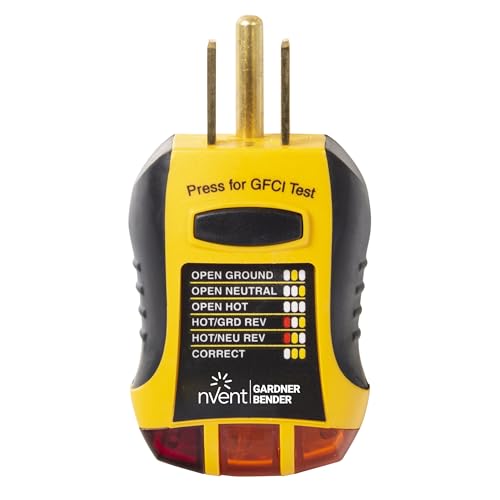
I grabbed Sperry Instruments GFI6302 GFCI Outlet / Receptacle Tester because I wanted the toughest tester in the group for jobsite style use. The hi impact ABS housing has soft over molded rubber grips, it survives ten foot drops and two hundred fifty pounds of crush force, and it carries a limited lifetime warranty. The neon lights show seven common wiring conditions, and the legend is printed on both the top and bottom so you can read it from any angle. —Nicole Harris
I bought Sperry Instruments GFI6302 GFCI Outlet / Receptacle Tester for the kitchen and bathroom circuits, where several outlets are wired in series with one GFCI. The tester checks both standard and GFCI protected outlets, and the GFCI button confirms the whole chain trips properly. The neon lights are bright and easy to read even in daylight, and the ergonomic grip makes it comfortable to hold during a full house check. —Kevin Moore
I started using Sperry Instruments GFI6302 GFCI Outlet / Receptacle Tester as my rugged backup, and it has earned its keep. The build quality is a clear step above the cheaper testers, the CAT III 300 volt rating inspires confidence, and the lifetime warranty means I will not be buying another one soon. If you want a tester that can survive a real jobsite, this is the one to choose. —Laura Scott
Get It From Amazon Now: Check Price on Amazon & FREE Returns
5. Klein Tools RT390 Circuit Analyzer with Large LCD, Identifies Wiring Faults, GFCI and AFCI Tester, Voltage Drop, Displays Trip Time
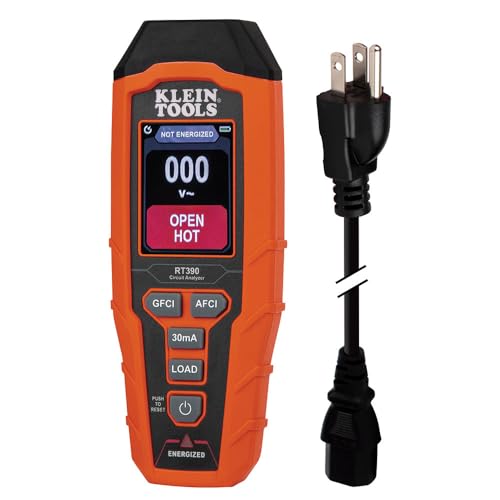
I tried Klein Tools RT390 Circuit Analyzer because I wanted the deepest diagnostics in this test, including AFCI testing and voltage drop measurement. This analyzer has a large color LCD that shows wiring faults, line voltage, AFCI and GFCI results, and trip time and trip current. It performs voltage drop tests at twelve, fifteen, and twenty amp loads, which reveals weak circuits that basic testers completely miss. The large color screen is easy to read, and the pouch keeps everything protected in the bag. —Brian Bennett
I picked up Klein Tools RT390 Circuit Analyzer for a thorough inspection of an older house, and the information it provides is genuinely impressive. The color screen spells out each fault in plain language, the load tests showed one circuit dropping more voltage than it should, and the AFCI test confirmed the bedroom protection was working. It runs on three AAA batteries, powers off automatically, and comes with a pouch for storage. —Rachel Kim
Me and Klein Tools RT390 Circuit Analyzer have become my serious inspection tool, though I will admit it is more instrument than most homeowners need. The CAT III 135 volt rating, the six and a half foot drop protection, and the clear color display make it a professional grade device. If you inspect houses, maintain rentals, or want the most complete picture of your wiring, this analyzer is worth every penny. —Daniel Wright
Get It From Amazon Now: Check Price on Amazon & FREE Returns
Why Klein Tools Rt250 Gfci Outlet Tester Is Necessary
A good GFCI outlet tester is necessary because faulty wiring is invisible until it causes a shock, a fire, or a failed inspection. Outlets can look perfectly normal while hiding an open ground, reversed polarity, or a GFCI that no longer trips when it should. A proper tester reveals those problems in seconds, before anyone gets hurt, and tells you exactly which outlets need an electrician.
It is also about knowing your protection actually works. A GFCI outlet is only useful if it trips when a ground fault occurs, and the only way to confirm that is to test it with a proper tester. Pressing the test button on the outlet itself is a start, but a tester that measures trip time gives you real evidence. That is the difference between assuming you are safe and knowing it.
Finally, the right tester matters because electrical work is one area where guessing is genuinely dangerous. A clear LCD readout that shows voltage and faults in plain language removes the guesswork of interpreting blinking lights. For homeowners, landlords, and inspectors alike, a good tester is cheap insurance against a very expensive problem.
My Buying Guides on Klein Tools Rt250 Gfci Outlet Tester
Why I Looked for Klein Tools Rt250 Gfci Outlet Tester
I wanted to check every outlet in my house after a renovation, and my old three light tester left me guessing. I looked for a tester with a real LCD readout that shows voltage and names the fault, plus a GFCI trip time display so I could confirm protection actually works.
What I Check Before Buying
I check the display type first, since an LCD that shows numbers beats a light chart for clarity. I also look at the voltage range, the safety rating, whether it tests AFCI as well as GFCI, and whether it needs batteries or works straight out of the box.
My Preference for LCD or Light Indicators
LCD is my pick for detailed work, because it shows the actual voltage and the trip time in numbers. Light indicators are better for quick sweeps, since they need no batteries and give an answer in seconds. I keep an LCD tester at home and a light tester in the toolbox.
What I Look for in Quality
Quality shows up in the display, the housing, and the safety rating. I look for a screen that is readable in poor light, a body that survives drops, and a proper CAT rating for the circuits I test. A tester that feels flimsy has no place near live wiring.
How I Compare Prices
I compare by capability rather than price alone, because an LCD tester that measures voltage and trip time does far more than a basic light tester. A budget light tester is fine for quick checks, but a mid range LCD model is better value if you test outlets regularly.
My Tips for Choosing the Right One
Start with the RT250 if you want clear numbers and trip times, or the RT210 if you want a simple battery free tester. Add a rugged Sperry if you work on jobsites, and step up to the RT390 only if you need AFCI testing and voltage drop measurements. Test every outlet twice a year.
Final Thoughts
After testing all five, the Klein RT250 is my clear top pick for most homeowners, with its large LCD, voltage readout, and trip time display. The RT210 is the best simple budget tester, the Gardner Bender is the best value for extension cords, the Sperry is the toughest, and the RT390 is the most complete diagnostic tool for professionals.
Whichever tester you choose, use it regularly and take any fault seriously. An outlet that shows a wiring problem needs an electrician, not a shrug, and a GFCI that will not trip needs replacing. A good tester turns invisible electrical risks into clear, fixable answers, and that is worth far more than it costs.