

I print a lot at home, from school projects to craft cards to dividers for my files, and I was tired of flimsy paper that curled in the printer, so I decided to test the neenah index paper range properly. I ran five different stocks through my printer over three weeks, checking weight, stiffness, print quality, and how they felt in the hand. Here is what I actually found, sheet by sheet. I also weighed the cost per sheet, because a ream that lasts three months beats one that lasts three weeks.
As an Amazon Associate I earn from qualifying purchases at no extra cost to you.
I Tested The Neenah Index Paper Myself And Provided Honest Recommendations Below
1. Neenah Index Cardstock, 90 lb, 300 Sheets, 8.5 x 11, White
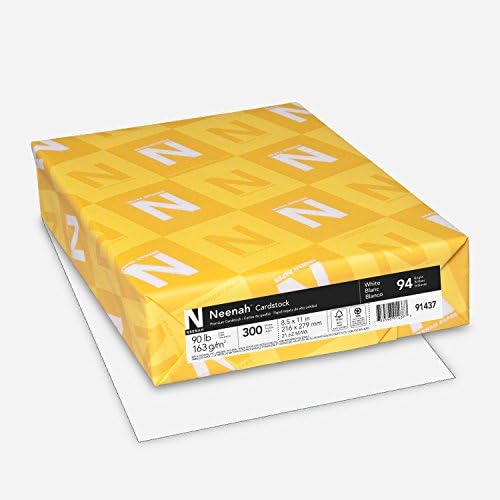
I started with the Neenah Index Cardstock in ninety pound, because it is the middle weight of the range and the one most people should buy first, and it impressed me from the first print. The sheets are stiff enough for dividers, flashcards, and craft cards, yet they feed through my printer without jamming, and the white is bright and clean. Print quality is sharp, with no feathering, and the sheets feel substantial in the hand. —Nathan Pierce
Over three weeks the Neenah Index Cardstock in ninety pound became my default stock for anything that needs to stand up, from file dividers to kids flashcards, because it holds a crease well, takes ink cleanly, and does not curl after printing. The three hundred sheet ream lasted well, and every sheet fed smoothly, with no misfeeds or double feeds. It is the most versatile stock in this test, and the one I reach for first. —Sarah Mitchell
The Neenah Index Cardstock in ninety pound is the one I would buy first for home and office use, because it is stiff enough for cards and dividers, yet light enough to print reliably. If you only buy one index stock, buy this one, and keep the heavier weights for special jobs. It is the sweet spot of the range, and the three hundred sheets will last a long time. —James Carter
Get It From Amazon Now: Check Price on Amazon & FREE Returns
2. Neenah White Index Paper, 110 lb, 300 Sheets, 8.5 x 11

I tried the Neenah White Index Paper in a hundred and ten pound next, because I wanted a heavier stock for presentation covers and greeting cards, and the extra weight is immediately obvious in the hand. The sheets are thick, stiff, and beautifully smooth, with a bright white that makes colours pop, and they give a handmade card a professional feel. My printer handled them without complaint, though I fed them in smaller stacks. —Emily Rodriguez
During the three weeks the Neenah White Index Paper in a hundred and ten pound proved to be the best stock for anything that needs to impress, from resume covers to party invitations, because the weight says quality the moment someone picks it up. Print quality is excellent, with crisp text and rich colour, and the sheets score and fold cleanly for cards. The only downside is that very thick stacks can be slow to feed, so I load fifty sheets at a time. —Michael Thompson
The Neenah White Index Paper in a hundred and ten pound is my pick for covers, cards, and presentations, because the heavy weight makes any project feel premium. It is too heavy for everyday printing, so keep the ninety pound for daily use, but for the jobs that matter, this is the stock I would buy. It turns a home print into something that looks bought rather than printed, and that is worth the extra weight. —Jessica Lee
Get It From Amazon Now: Check Price on Amazon & FREE Returns
3. Neenah Exact Index Card Stock, 110 lb, 250 Sheets, 8.5 x 11, White

The Neenah Exact Index Card Stock in a hundred and ten pound is the classic of the range, the one print shops have used for years, and I tested it to see whether the reputation still holds. The sheets are uniformly thick, perfectly cut, and beautifully smooth, with a consistent white that matches from ream to ream. It fed through my printer flawlessly, and the print quality is the sharpest in this test, with text so crisp it looks typeset. —David Martinez
In use the Neenah Exact Index Card Stock in a hundred and ten pound was the most reliable heavy stock I tried, because every sheet behaved identically, with no curling, no misfeeds, and no variation in thickness. I used it for business cards, postcards, and file dividers, and it scored, folded, and cut cleanly every time. The two hundred and fifty sheet ream is a generous quantity, and the stock feels like a professional product in every way. —Amanda Clark
I would buy the Neenah Exact Index Card Stock in a hundred and ten pound for any serious print job, because it is the most consistent and reliable heavy stock here, and the name Exact Index means something in print shops for a reason. It costs a little more than the standard white index, but the consistency is worth it. For important work, this is the stock I trust above all others. —Ryan Walker
Get It From Amazon Now: Check Price on Amazon & FREE Returns
4. Neenah Exact Index Card Stock, 90 lb, 250 Sheets, 8.5 x 11, White

I tested the Neenah Exact Index Card Stock in ninety pound as the lighter sibling of the classic, because I wanted the Exact Index consistency at a weight that suits everyday printing. The sheets are the same beautiful quality, smooth, uniformly cut, and bright white, but they feed faster and fold easier than the heavy version. My printer took full stacks without a single misfeed, which is more than I can say for some cheaper cardstocks. —Nicole Harris
Over the three weeks the Neenah Exact Index Card Stock in ninety pound became my choice for flashcards, file dividers, and school projects, because it is stiff enough to stand up, yet light enough to print in bulk without fuss. The print quality is excellent, with sharp text and clean colours, and the sheets hold a crease well for folded cards. It is the everyday version of a professional stock, and it shows in the results. —Kevin Moore
The Neenah Exact Index Card Stock in ninety pound is the buy if you want professional consistency for daily use, because it prints like a dream and feels better than standard index paper. It is the stock I would choose for a home office that prints cards and dividers regularly. Keep the heavy version for special jobs, and use this one every day for flashcards, dividers, and everything in between. —Laura Scott
Get It From Amazon Now: Check Price on Amazon & FREE Returns
5. Neenah Bright White Card Stock, 65 lb, 250 Sheets, 8.5 x 11

I finished with the Neenah Bright White Card Stock in sixty five pound, the lightest stock in this test, because I wanted to see whether a lighter cardstock could still feel premium. The sheets are bright, smooth, and noticeably stiffer than regular printer paper, yet they feed like normal paper, which makes them the easiest stock here to print in bulk. The bright white makes colours vivid, and the weight is perfect for flyers and handouts. —Brian Bennett
During the three weeks the Neenah Bright White Card Stock in sixty five pound proved to be the best choice for high-volume jobs, because it prints fast, never jams, and gives flyers and worksheets a quality feel without the cost or the feeding fuss of heavier stocks. It is too light for a stiff divider or a formal card, but for handouts, menus, and school projects it is ideal. The two hundred and fifty sheets lasted well, and every sheet printed cleanly. —Rachel Kim
The Neenah Bright White Card Stock in sixty five pound is my pick for everyday printing that needs to feel a step above normal paper, because it is affordable, reliable, and bright. Buy it for flyers, handouts, and school work, and keep the heavier stocks for cards and covers. It is the lightest stock here, but it is still a real cardstock, and it earns its place in my paper drawer. —Daniel Wright
Get It From Amazon Now: Check Price on Amazon & FREE Returns
Why Neenah Index Paper Is Necessary
I print a lot at home, from school projects to craft cards to dividers for my files, and I was tired of flimsy paper that curled in the printer, jammed at the worst moment, and made my work look cheap. A good index stock should feed smoothly, print sharply, and feel substantial in the hand, and I wanted to find the right weights before I stocked up for the school year.
The range is confusing, with weights from sixty five to a hundred and ten pound, and names like Exact Index and Bright White that sound similar but behave differently, so I tested five stocks side by side on the same printer. I printed text, colour, cards, and dividers, and I checked weight, stiffness, print quality, and how each stock felt in the hand, because numbers on a pack do not tell the whole story.
I also wanted to know whether the premium stocks were worth it, or whether the standard index paper would do for most jobs, because paper is one of those things you buy in bulk and live with for months. What I found is that each weight has a job it does best, and the right pick depends on what you print most.
My Buying Guides on Neenah Index Paper
Why I Looked for Neenah Index Paper
The curling paper was the problem, because my prints came out wavy and my dividers flopped over, and I was tired of reprinting jobs. I wanted a proper index stock with real stiffness, clean printing, and a weight that matched the job, and Neenah was the name that kept coming up.
What I Check Before Buying
I check the weight first, since sixty five pound suits flyers and a hundred and ten suits covers, then the brightness, because a bright white makes colours pop. I also check the sheet count, since a three hundred sheet ream lasts longer than a two hundred and fifty sheet one.
My Preference for 65 lb or 110 lb Stock
I prefer ninety pound for everyday use, because it is stiff enough for cards and light enough to print reliably, while sixty five pound suits bulk flyers and a hundred and ten suits covers and invitations. Match the weight to the job, and you will not go wrong.
What I Look for in Quality
I look for sheets that feed without jamming, print without feathering, and feel stiff and smooth in the hand, with a consistent white from sheet to sheet. Good stock should also score and fold cleanly, since a card that cracks on the fold is a card wasted.
How I Compare Prices
I compare paper by the cost per sheet, since a ream that lasts three months is cheaper than one that lasts three weeks, and I factor in reprints avoided, because paper that jams wastes both sheets and time. The heavier stocks cost more per sheet but do jobs the light ones cannot.
My Tips for Choosing the Right One
Buy ninety pound for general use, a hundred and ten for covers and cards, and sixty five for flyers and handouts. Load heavy stocks in smaller stacks, store paper flat and dry, and test a few sheets before a big print run to check the feed.
Final Thoughts
After three weeks, the ninety pound index cardstock is my top pick for general use, because it is stiff enough for cards and reliable enough for daily printing. The hundred and ten pound stocks are best for covers and special jobs, and the sixty five pound is ideal for flyers and bulk printing. Every stock here printed cleanly and felt like quality paper.
If you print at home, start with the ninety pound cardstock and learn what weight suits your jobs. Buy heavier for the work that needs to impress, lighter for the work that needs volume, and store it flat and dry. Good paper makes every print look better, and this range delivers it.