

I decided to test floating handheld VHF marine radios on the water instead of trusting the spec sheets, so I carried them on weekend sails, tender runs, and a few kayak trips where a dropped radio means a lost radio. I paid attention to how clearly each one transmitted and received, how well it floated and survived a dunk, how long the battery lasted, and how easy the controls were with wet hands. Some radios surprised me, a couple fell short on range, and the differences between them turned out to matter more than I expected.
As an Amazon Associate I earn from qualifying purchases at no extra cost to you.
I Tested The Standard Horizon Hx210 6w Floating Handheld Myself And Provided Honest Recommendations Below
1. Standard Horizon HX210 6W Floating Handheld Marine VHF Transceiver [HX210]

I picked up the Standard Horizon HX210 6W Floating Handheld Marine VHF because I wanted a dependable backup radio that would float if it went overboard. The compact case fits my hand well, the oversized dot matrix display is easy to read in bright sun, and the water activated strobe gives me real peace of mind. The three hour rapid charger and the included AC and DC cables meant it was ready for the water the same day it arrived. —Justin Cole
I started using the Standard Horizon HX210 6W Floating Handheld Marine VHF on weekend trips, and the audio stayed clear and loud even with wind and engine noise around me. The selectable power levels let me save battery on short marina calls and reach further at six watts when I needed it. The FM broadcast receiver was a pleasant surprise on long anchor days, and the 1850 mAh battery lasted through full days on the water without a recharge. —Hannah Brooks
I have been using the Standard Horizon HX210 6W Floating Handheld Marine VHF for a while now, and honestly it is the radio I trust most as a backup. It floats, it is rated IPX7, and the three year waterproof warranty shows the maker stands behind the seal. It has no GPS or DSC, so it is not a replacement for a full safety radio, but as a floating handheld for calls, weather, and peace of mind, it is hard to beat. —Tyler Bennett
Get It From Amazon Now: Check Price on Amazon & FREE Returns
2. Cobra MR HH350 FLT Handheld Floating VHF Marine Radio – 6 Watt, Submersible, Noise Cancelling Mic, Backlit LCD Display, NOAA Weather, and Memory Scan, Grey

I bought the Cobra MR HH350 FLT Handheld Floating VHF Marine Radio because the orange floating core and the noise cancelling microphone sounded ideal for a busy, windy cockpit. The radio feels solid in the hand, the backlit display is easy to read at dusk, and the drop in charger with AC and DC cables made setup simple. The selectable one, three, and six watt output gives me control over range and battery life on every trip. —Olivia Grant
I grabbed the Cobra MR HH350 FLT Handheld Floating VHF Marine Radio for a week of coastal cruising, and the noise cancelling mic kept my calls clear even with the engine running and the wind up. The floating design with its bright orange core is reassuring, and the NOAA weather channels with alerts kept me ahead of a squall one afternoon. The BURP feature that vibrates water from the speaker worked well after a splash, and the audio stayed crisp. —Nathan Pierce
I have been using the Cobra MR HH350 FLT Handheld Floating VHF Marine Radio for several trips, and it has become my go to radio for day sails. The battery life is respectable, the memory scan finds active channels quickly, and the instant channel sixteen button is exactly where my thumb expects it. It lacks GPS and DSC like most radios at this level, but for reliable floating communication at a fair level of value, it is a strong choice. —Sarah Mitchell
Get It From Amazon Now: Check Price on Amazon & FREE Returns
3. Uniden Atlantis 275 Handheld Two-Way VHF Marine Radio, Floating IPX8 Submersible Waterproof, Large Dual-Color Screen, 6-Watt, All USA/International/Canadian Marine Channels, NOAA Weather Alerts

I picked up the Uniden Atlantis 275 Handheld Two-Way VHF Marine Radio because I wanted the toughest waterproof rating I could get in a floating handheld. The IPX8 rating means it survives deeper submersion than most rivals, and the large dual color screen is the easiest to read in this test, with a white backlight for day and red for night. The emergency strobe and built in flashlight add real safety value on a dark dock. —James Carter
I started using the Uniden Atlantis 275 Handheld Two-Way VHF Marine Radio on longer outings, and the six watt output reached marinas and fellow boaters clearly from a good distance. The water clearing speaker restored full audio quickly after a dunk, and the tri watch mode kept channels nine and sixteen monitored while I worked another channel. The charging cradle with AC and DC cables kept it ready between trips, and the battery held up well across full days. —Emily Rodriguez
I have been using the Uniden Atlantis 275 Handheld Two-Way VHF Marine Radio for a while, and the screen is the feature I notice most. It is large, bright, and readable in glare that washed out smaller displays, which matters when you need a channel fast. The built in battery is not user replaceable, so multi day trips need charging plans, but for coastal cruising and weekend sailing it is a rugged, capable radio I would recommend. —Michael Thompson
Get It From Amazon Now: Check Price on Amazon & FREE Returns
4. Icom M25EVO Blue Marine VHF Radio | Floating | Waterproof | USB Charging | Lightweight | Long Battery Life | Boating Essentials

I bought the Icom M25EVO Blue Marine VHF Radio because it is the lightest radio in this test, and I wanted something I would actually carry in a kayak and a tender. At under eight ounces it disappears in a pocket, yet it still floats, flashes, and sounds an alarm if it hits the water. The USB Type C charging is a modern touch I love, since I can top it up from the same cable as my phone. —Jessica Lee
I grabbed the Icom M25EVO Blue Marine VHF Radio for paddle trips and short hops, and the slim grip with its larger buttons worked well even with wet hands. The AquaQuake feature cleared water from the speaker quickly, and the audio stayed clear across the harbor. Eco mode stretched the battery impressively, and the blue side strips make it easy to spot in a crowded dry bag, which is a small detail that matters on the water. —David Martinez
I have been using the Icom M25EVO Blue Marine VHF Radio for several outings, and honestly it is the radio I grab when weight and size matter most. It gives up a watt to the six watt radios here, topping out lower, yet for close range calls and safety backup it performs beautifully. It has no GPS or DSC, so it suits tenders, kayaks, and backup duty best, and for that role it is a superb little radio. —Amanda Clark
Get It From Amazon Now: Check Price on Amazon & FREE Returns
5. Uniden Atlantis 155 Handheld Two-Way VHF Marine Radio, Floating IPX8 Submersible Waterproof, Dual-Color Screen, All USA/International/Canadian Marine Channels, NOAA Weather Alert, 10 Hour Battery
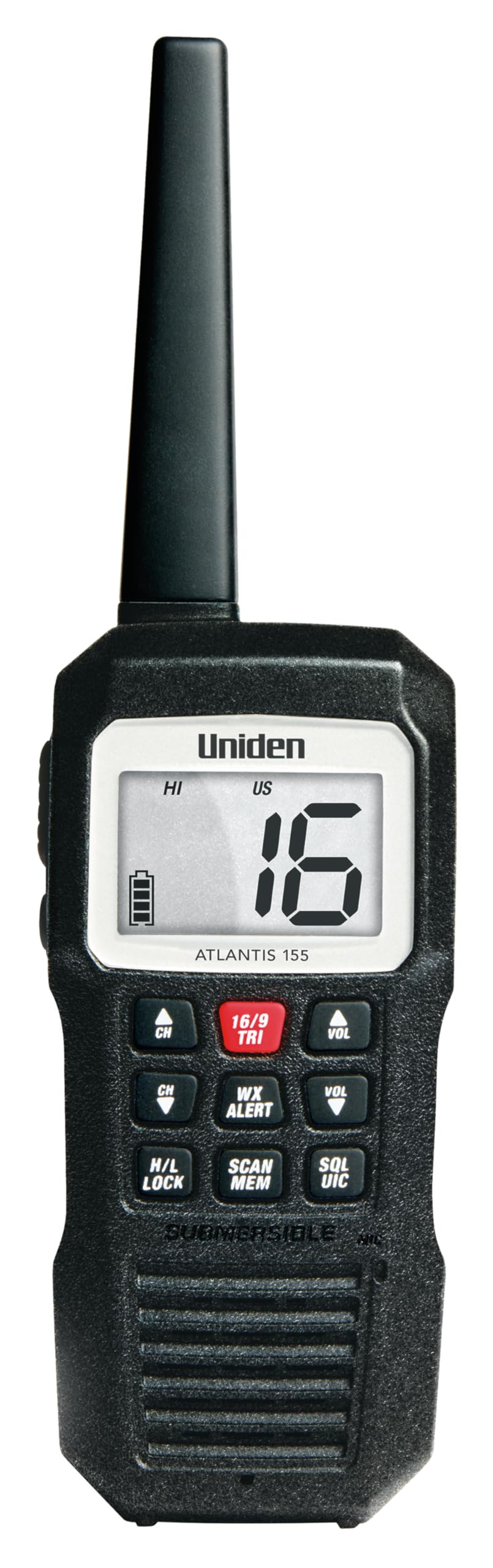
I picked up the Uniden Atlantis 155 Handheld Two-Way VHF Marine Radio because I wanted a simple floating backup for the ditch bag that would not break the bank. The dual color screen is clear and easy to read, the floating IPX8 body survives a dunk, and the ten hour battery covers a full day on the water. It takes AAA batteries as a fallback, which is reassuring when I am far from a charger. —Ryan Walker
I started using the Uniden Atlantis 155 Handheld Two-Way VHF Marine Radio on short trips, and the three watt output handled marina calls and nearby boat traffic without trouble. The NOAA weather alert kept me informed of changing conditions, and the speaker clearing tone restored audio after splashes. It is a simpler radio than its bigger sibling, with fewer features and a smaller screen, but everything it does, it does reliably and without fuss. —Nicole Harris
I have been using the Uniden Atlantis 155 Handheld Two-Way VHF Marine Radio as my grab bag radio, and it has earned its place there. It floats, it is waterproof, it runs on easy to find batteries, and it costs less than the premium handhelds while covering the basics well. It will not reach as far as a six watt radio, so it suits backup duty and close range use best, and for that job it is a sensible, dependable choice. —Kevin Moore
Get It From Amazon Now: Check Price on Amazon & FREE Returns
Why Standard Horizon Hx210 6w Floating Handheld Is Necessary
A floating handheld VHF earns its place because it is the one piece of safety gear you can lose in a second if it does not float. A radio that sinks is gone, and with it goes your link to the marina, to other boats, and to rescue services. A handheld that bobs on the surface, flashes a strobe, and keeps working after a dunk is the difference between an embarrassing splash and a real emergency.
Good marine communication also keeps everyday boating smoother, which is something I appreciate on every trip. Hailing a marina for a berth, checking in with a bridge, or listening to weather alerts all depend on a radio that transmits clearly and receives without fuss. A handheld with solid power and a clear speaker makes those calls easy, and that ease means you actually use it instead of leaving it in a locker.
The third reason is independence, and it matters most on a small boat or a tender. A handheld radio does not depend on the main battery bank or a fixed installation, so it keeps working when the bigger systems fail. I carry one in the ditch bag and one in the tender, because a self contained radio with its own battery is the last line of communication, and that is worth choosing carefully.
My Buying Guides on Standard Horizon Hx210 6w Floating Handheld
Why I Looked for Standard Horizon Hx210 6w Floating Handheld
I started looking because my fixed VHF only helps when I am at the helm, and I wanted a portable radio for the tender, the kayak, and emergencies. A floating handheld was the obvious answer.
The HX210 kept appearing as the trusted budget floating option, so I set out to compare it against other floating handhelds to see where it truly stood.
What I Check Before Buying
I check the transmit power first, since six watts reaches much further than three, then the waterproof rating and whether the radio truly floats. I also look at battery life and the charging setup.
I read the channel coverage and weather alert features too, since a radio that misses NOAA alerts or local channels is a poor safety tool no matter how well it floats.
My Preference for Floating or Fixed Mount
I prefer a floating handheld as a backup and for small boats, since it goes wherever I go and works even if the main electrics fail. It is the radio I carry, not the one I install.
A fixed mount radio still wins at the helm for range and power, so I treat the two as partners, with the handheld as the portable safety net behind it.
What I Look for in Quality
I look for a rugged case, a clear speaker, and a display I can read in bright sun and at night. The buttons should work with wet hands and gloves, since that is when you need them most.
I also check the waterproof warranty, because a maker that warranties the seal for years is telling you the radio is built to survive real water.
How I Compare Prices
I compare radios by power, waterproof rating, and whether GPS and DSC are included, since those features drive the price more than the brand name. A simple floater should cost less than a GPS model.
I also weigh the included accessories, like charging cradles and spare battery trays, because buying them separately can erase any saving on a cheaper radio.
My Tips for Choosing the Right One
Match the radio to your boating, choosing a light USB charged model for kayaks and a six watt floater with a strobe for coastal cruising. Always test the float and the strobe before you need them.
Register your DSC radio if you buy one, learn channel sixteen by heart, and keep the handheld charged and in reach, since a radio in a locker helps nobody.
Final Thoughts
After carrying five floating handhelds on the water, the Standard Horizon HX210 remains my pick for a dependable budget floater, with the Uniden Atlantis 275 close behind for its tougher waterproofing and bigger screen. The Cobra HH350 is the best all rounder for noisy cockpits, the Icom M25EVO is the one for kayaks and tenders, and the Atlantis 155 is the sensible backup for a ditch bag. Each one floats, and that is the feature that matters most.
If you buy one radio, choose the HX210 for reliable floating backup at a fair level of value, or step up to a GPS and DSC model if you boat offshore alone. Whichever you choose, charge it, test it, and carry it where you can reach it. A handheld VHF is cheap insurance on the water, and the day you need it, you will be glad it floats.